The present perfect and past simple tenses are two commonly used verb tenses in English, and they have distinct differences in terms of their usage and meaning. Let’s explore these differences:
Differences between Present Perfect and Past Simple
Time Frame
Present Perfect
The present perfect tense is used to talk about past actions or events that have a connection to the present. It focuses on the result or impact of the action rather than the specific time it occurred. It is often used with time expressions like “ever,” “never,” “already,” “yet,” and “just.”
Past Simple
The past simple tense is used to describe completed actions or events that happened at a specific time in the past. It indicates that the action is finished and not connected to the present.
Signal Words
Present Perfect
Signal words commonly associated with the present perfect tense include “since,” “for,” “recently,” “lately,” “already,” “just,” “ever,” and “never.”
Past Simple
Signal words used with the past simple tense include specific time expressions such as “yesterday,” “last week,” “two years ago,” “in 2010,” and other time markers that indicate a definite past time.
Verb Form
Present Perfect
The present perfect tense is formed by using the auxiliary verb “have” or “has” (depending on the subject) followed by the past participle of the main verb (e.g., “I have seen,” “She has eaten”).
Past Simple
The past simple tense is formed by using the base form of the verb with regular verbs and adding “-ed” or irregular verb forms (e.g., “I walked,” “She ate”).
Focus on Result vs. Specific Time
Present Perfect
The present perfect tense focuses on the result or impact of the action. It emphasizes the connection between past actions and the present moment.
Past Simple
The past simple tense focuses on the specific time when the action happened in the past. It does not emphasize the connection to the present.
Relevance to the Present
Present Perfect
The present perfect tense highlights the relevance of past actions or events to the present. It often implies that the action has an ongoing effect or consequence.
Past Simple
The past simple tense refers to a specific point in the past without any direct relevance to the present.
Examples:
- Present Perfect:
- I have visited Paris. (The action of visiting Paris is connected to the present; it implies that I have been to Paris at some point in my life.)
- She has already finished her homework. (The focus is on the completion of the homework; it is relevant to the present moment.)
- Past Simple:
- I visited Paris last year. (The action of visiting Paris is in the past, with no direct connection to the present.)
- She finished her homework yesterday. (The focus is on the completion of the homework at a specific past time.)
In summary, the present perfect tense emphasizes the result or impact of past actions relevant to the present, while the past simple tense describes completed actions at a specific past time without a direct connection to the present. Understanding the differences between these two tenses is essential for accurate and effective communication in English.
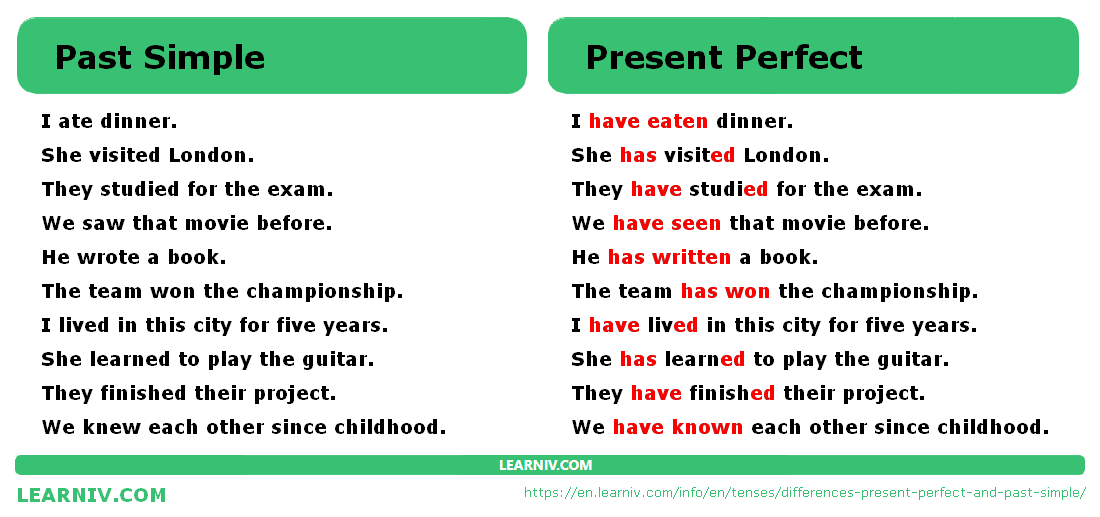
Compare sentences in present perfect and past simple tense.
| Present Perfect | Past simple |
|---|---|
| I have eaten dinner. | I ate dinner. |
| She has visited London. | She visited London. |
| They have studied for the exam. | They studied for the exam. |
| We have seen that movie before. | We saw that movie before. |
| He has written a book. | He wrote a book. |
| The team has won the championship. | The team won the championship. |
| I have lived in this city for five years. | I lived in this city for five years. |
| She has learned to play the guitar. | She learned to play the guitar. |
| They have finished their project. | They finished their project. |
| We have known each other since childhood. | We knew each other since childhood. |
Present Perfect tense
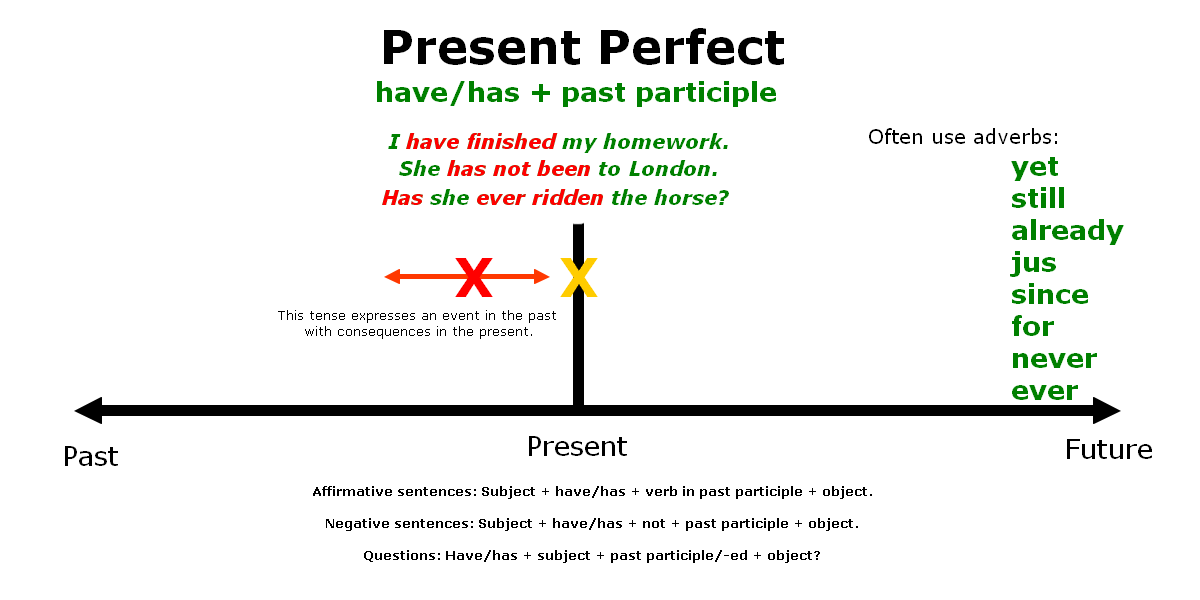
The present perfect tense is a combination of the present tense and perfect aspect that expresses an event in the past with consequences in the present.
For this tense we use auxiliary verbs in their base form in combination with main verbs in their past participle form. This tense is quite easy to learn but harder to use in practice, but nonetheless it’s a tense we must know. To properly construct sentences, we have to learn all the irregular verbs and know their forms.
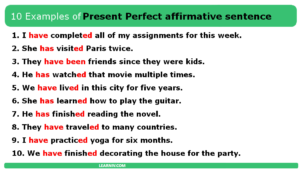
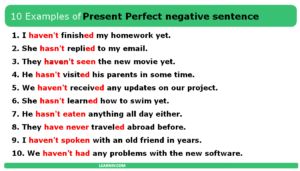
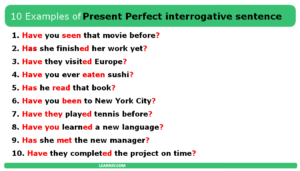
Look at present perfect tense examples.
Examples of sentences of Present perfect tense
Other examples:
- 5 examples of sentences of Present Perfect tense
- 10 examples of sentences of Present Perfect tense
- 20 examples of sentences of Present Perfect tense
- 50 examples of sentences of Present Perfect tense
- Present Perfect irregular and regular verbs list
- Present perfect tense examples
Past simple tense
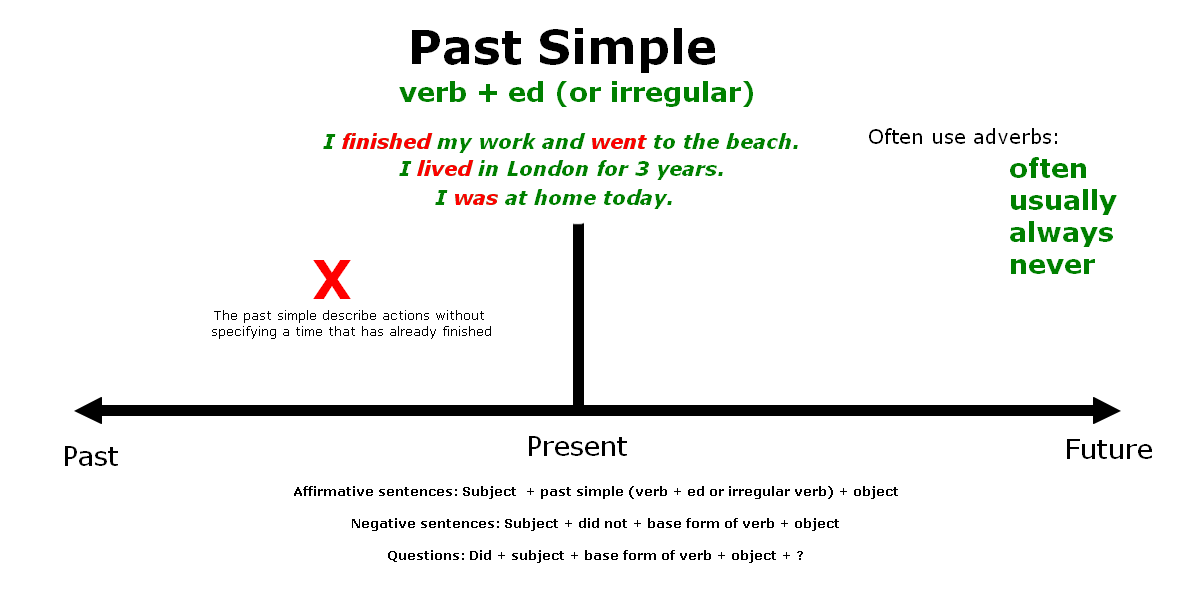
The past simple tense (sometimes called preterite, simple past or past indefinite) is the basic form of the past tense. This is one of the most common past tenses and can describe a lot of events. It is really important to know how and when to use this tense for daily conversation.
The term „simple“ is used because it distinguishes syntactic sentences from the auxiliary of the past perfect or past progressive tense. The past simple is one of the easiest tenses to learn, which is one reason why this tense is called the past simple tense.
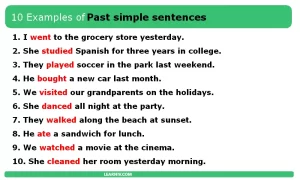
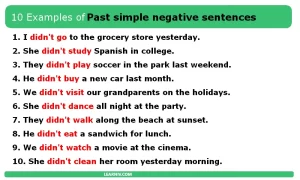
Look at past simple tense examples
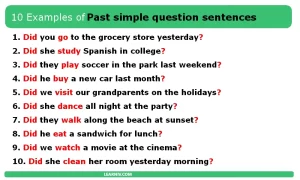
More examples of Past Simple sentences
Other examples: