Verbs in the English language can be classified into regular and irregular verbs based on how their past tense forms are created. Let’s explore how to form the past tense of verbs and categorize them accordingly:
This post is inspired and sponsored by: irregular-verbs-english.com
Regular verbs in past simple
Regular verbs in the past simple tense follow a predictable pattern when forming the past tense. The general rule is to add the suffix “-ed” to the base form of the verb. Here are some examples of regular verbs grouped based on their endings:
Verbs ending in -ed
| Base Form | Past Tense |
|---|---|
| Walk | Walked |
| Talk | Talked |
| Laugh | Laughed |
Verbs ending in -d or -ed
| Base Form | Past Tense |
|---|---|
| Play | Played |
| Clean | Cleaned |
| Move | Moved |
Verbs ending in -ied
| Base Form | Past Tense |
|---|---|
| Study | Studied |
| Try | Tried |
| Carry | Carried |
Irregular verbs in past simple
Irregular verbs in the past simple tense can be categorized into different groups based on the endings they have in their past tense forms. Let’s divide some irregular verbs into groups:
Group 1 – Verb base form ends in “ay” and past tense ends in “id”
| Base Form | Past Tense |
|---|---|
| Say | Said |
| Pay | Paid |
Group 2 – Verb base form ends in “ee” and past tense ends in “ew”
| Base Form | Past Tense |
|---|---|
| See | Saw |
Group 3 – Verb base form ends in “ow” and past tense ends in “ew”
| Base Form | Past Tense |
|---|---|
| Grow | Grow |
| Know | Know |
In this special article you will learn about the past tense of the verb READ.
Group 4 – Verb base form ends in “ight” and past tense ends in “ought”
| Base Form | Past Tense |
|---|---|
| Fight | Fought |
| Buy | Bought |
| Think | Thought |
Group 5 – Verb base form ends in “ind” and past tense ends in “ound”
| Base Form | Past Tense |
|---|---|
| Find | Found |
Group 6 – Verb base form ends in “ell” and past tense ends in “elt”
| Base Form | Past Tense |
|---|---|
| Tell | Told |
These are just a few examples of irregular verbs divided into different groups based on their past tense endings. It’s important to note that irregular verbs do not follow a specific pattern, and each verb may have its own unique past tense form. Therefore, it’s essential to familiarize yourself with irregular verbs individually to use them correctly in past tense sentences.
What is the past simple tense and its uses
The past tense is a grammatical form used to indicate that an action, event, or state of being occurred in the past. It is one of the essential verb tenses in English and allows us to express actions or situations that have already happened and are completed.
We use the past tense in various situations
Describing Past Actions
The primary use of the past tense is to talk about actions or events that happened in the past. For example:
-
- She walked to the store.
- They played soccer yesterday.
- I studied for the exam last night.
Narrating Past Events
When telling stories or recounting past experiences, we use the past tense to describe what happened. It helps create a sense of time and sequence. For example:
-
- Once upon a time, there lived a princess.
- Last summer, we traveled to Europe and visited several countries.
Referring to Past Habits or Routines
We use the past tense to talk about actions or habits that were regularly performed in the past but may no longer occur. For example:
-
- I used to play the piano when I was younger.
- Every morning, he went for a run.
- We always had dinner together as a family.
Reporting Past Facts or Events
When conveying information about historical events, scientific discoveries, or news from the past, the past tense is commonly used. For example:
-
- The Berlin Wall fell in 1989.
- Shakespeare wrote many famous plays.
- The company announced a new product last week.
By using the past tense, we provide a temporal context and convey that an action or event took place before the present moment. It allows us to express completed actions and helps establish a clear timeline when communicating in English.
It’s important to note that regular verbs generally form their past tense by adding “-ed” to the base form, while irregular verbs have unique past tense forms that need to be memorized. Consistency in tense is crucial, and understanding how to use the past tense accurately will enhance your ability to communicate effectively in both spoken and written English.
Examples of Past Simple sentences
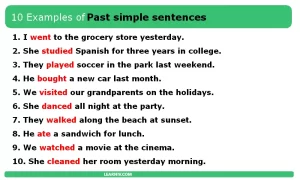
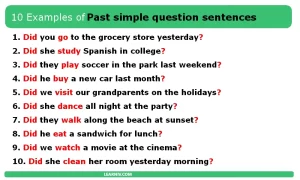
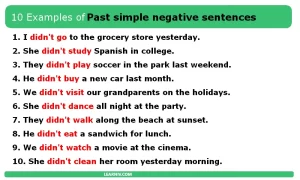
More examples:
- 5 examples of sentences of simple past
- 10 examples of simple past tense
- 20 examples of simple past tense
- 100 examples of simple past tense
- Other examples of sentences of simple past
- Verbs in Past simple
- Differences: Present Perfect and Past Simple
- Past Simple Negative form
- Past simple affirmative negative and interrogative structure