

The present continuous (progressive) form is a fundamental aspect of the English language. It allows us to describe actions or situations happening at the current moment or in the near future. In this blog post, we will delve into the structure of the present continuous tense (also known as present progressive tense), exploring its components and providing examples for a better understanding. Whether you’re a beginner or looking for a quick refresher, this guide will equip you with the knowledge to master this essential verb form.
Understanding the Structure of the Present Continuous (progressive) Form
The present continuous (progressive) tense is formed by using the present participle (also known as the -ing form) of the main verb in combination with the auxiliary verb “to be.” The structure can be broken down into the following components:
- Subject: The subject of the sentence represents the person or thing performing the action.
- Auxiliary Verb: The auxiliary verb “to be” is used in the present tense, indicating the ongoing nature of the action. The form of the auxiliary verb changes according to the subject:
- Singular: am (I), is (he/she/it)
- Plural: are (we/you/they)
- Present Participle: The present participle is formed by adding -ing to the base form of the main verb. However, keep in mind that some verbs may undergo spelling changes. For example:
- Base Form: work
- Present Participle: working
- Object: The object is optional and represents the receiver of the action.
Look at the differences between present simple and present continuous.
Affirmative sentences in the present continuous (progressive) tense
In affirmative sentences, we use the verb „to be“ in its present tense in combination with a verb and the suffix –ing. We have to distinguish between the person of the subject in every sentence to know how and when to use the correct form of the verb „to be“. We will only use the forms „am“, „is“ or „are“.
Once we know which form of the verb we have to use, we just add a verb with the –ing form.
The sentence will look as follows:
Subject + to be (am/is/are) + verb +(-ing) + object.

Tip: present continuous passive voice
Negative sentences in the present continuous (progressive) tense
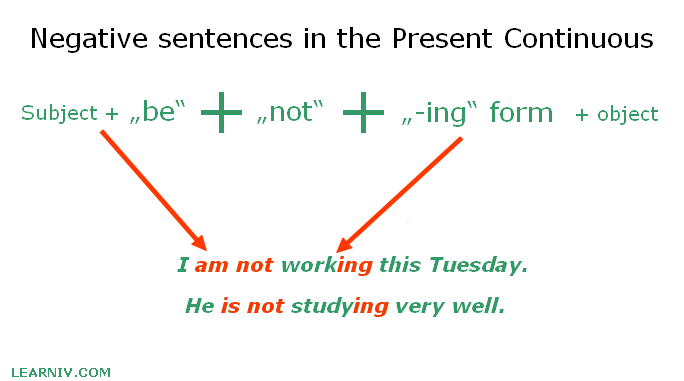
To construct a negative sentence in this tense, we have to add the word „not“ after the auxiliary verb „to be“. If we want to describe the negative meaning, we must use the form „to be“ + not.
We must ensure we use the correct form of the verb „to be“.
In formal conversations, we always use the full form as it is more polite. In non-formal conversations, we can use all short-forms.
The sentence will look as follows:
Subject + to be (am, are, is) + not + verb+(-ing) + object.
Questions
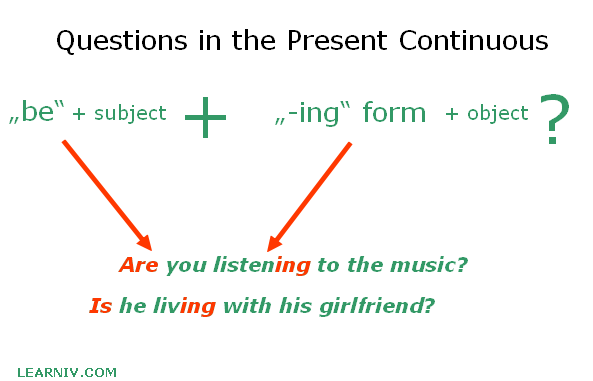
To construct a question we have to put the verb „to be“ at the beginning of the sentence, in front of the subject. The rest of the sentence is similar to that of an affirmative sentence. Again, we add the suffix –ing to the base form of the verb.
The sentence will look as follows:
To be (am, are, is) + subject + verb +(-ing) + object?
Examples of Present Continuous (progressive) form in sentences
To better illustrate the structure of the present continuous (progressive) form, let’s take a look at a few examples:
- Affirmative:
- I am studying for my exams.
- She is playing the piano.
- They are watching a movie.
- Negative:
- We are not going to the party.
- He is not working on Sundays.
- They are not studying abroad.
- Interrogative:
- Are you coming to the meeting?
- Is she eating dinner now?
- Are they playing football in the park?
Remember, the present continuous form is versatile and can be used to describe actions happening at the moment of speaking, temporary situations, future plans, or ongoing trends.
More examples of Present Continuous sentences
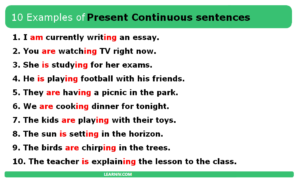
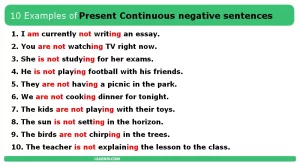
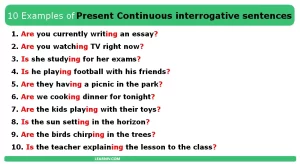
- Present continuous sentences
- 100 sentences of present continuous tense
- 50 sentences of present continuous tense
- 30 sentences of present continuous tense
- 20 sentences of present continuous tense
- 10 sentences of present continuous tense