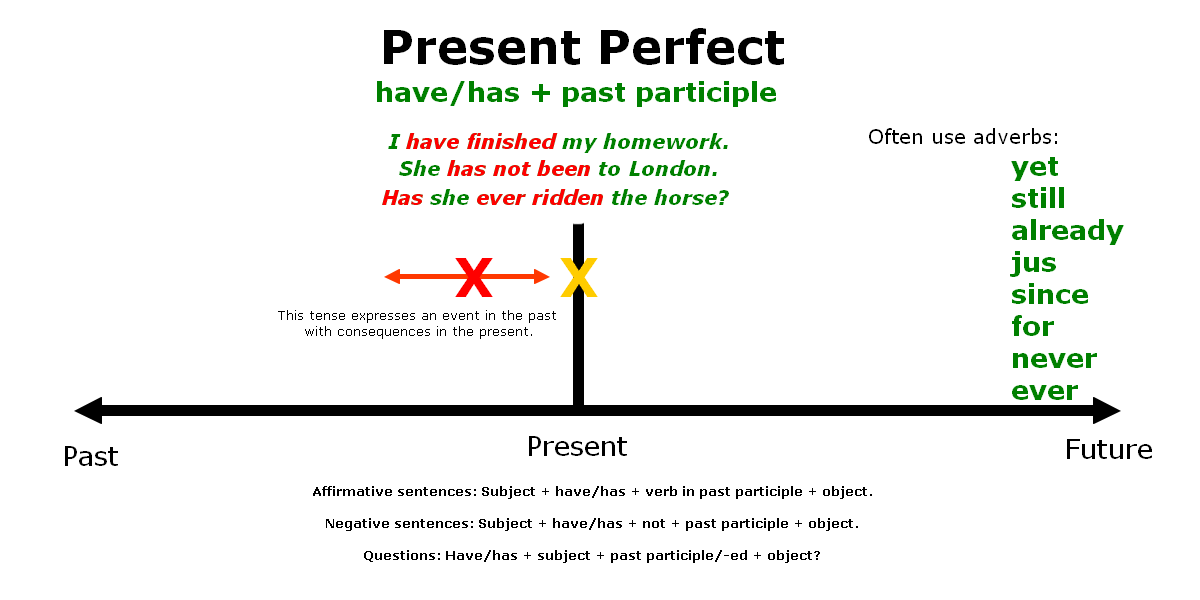
Understanding the Present Perfect tense is essential for English learners. In this comprehensive guide, we will explore the Present Perfect formula step by step, providing you with a clear understanding of its structure and usage. By mastering this tense, you will enhance your communication skills and express yourself more accurately in English.
What is the Present Perfect Tense?
Introduction to the Present Perfect Tense
The Present Perfect tense is a grammatical structure used to describe actions or situations that started in the past but have a connection to the present moment. It is formed by combining the auxiliary verb “have” (in its various forms) with the past participle of the main verb. This tense is widely used in English and is crucial for expressing experiences, achievements, unfinished actions, and results with present relevance.
Structure of the Present Perfect Tense
To form the Present Perfect tense, we use the auxiliary verb “have” or “has” (depending on the subject) followed by the past participle of the main verb. For example, “I have seen,” “She has studied,” or “They have traveled.” It is important to note that the auxiliary verb “have” undergoes changes according to the subject, such as “I have,” “You have,” “He has,” “She has,” “It has,” “We have,” and “They have.”
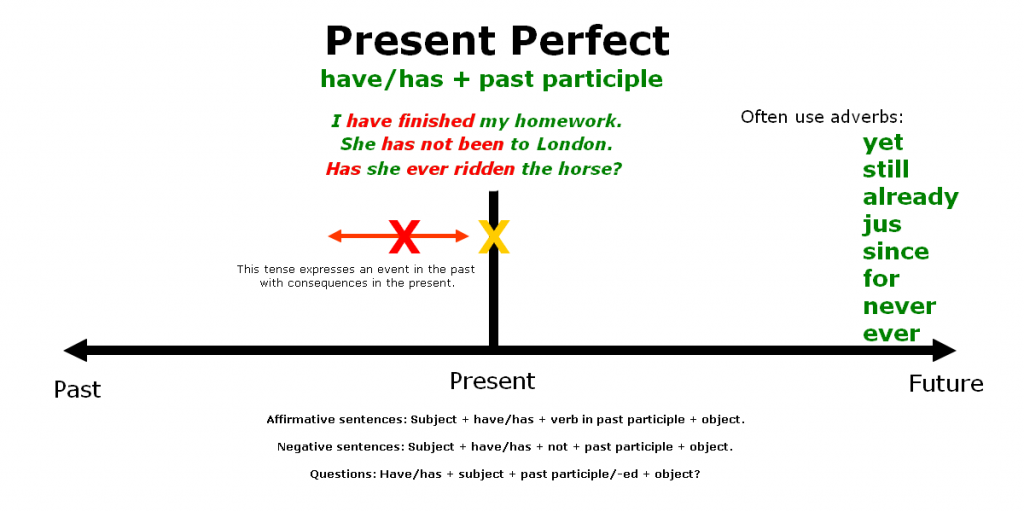
Structure of the sencences
In the Present Perfect tense, sentences are structured differently depending on whether they are affirmative, negative, or interrogative. Let’s explore the structure of each type:
Affirmative Sentences
In affirmative sentences, we express actions or events that have occurred in the past and have a connection to the present. The structure of affirmative sentences in the Present Perfect tense is as follows:
Subject + have/has + past participle + (complement)
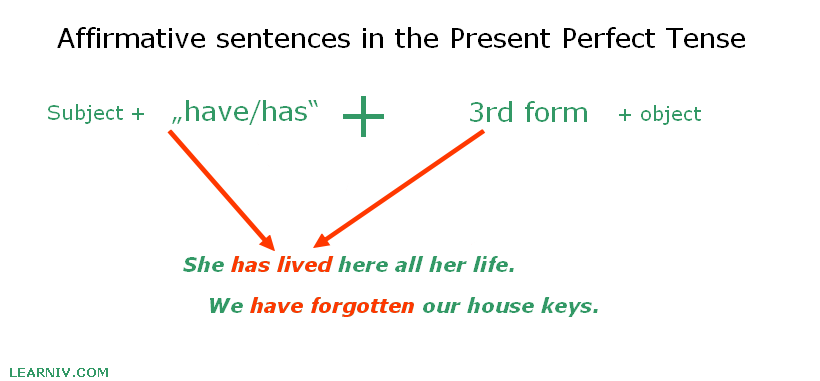
Example:
- I have studied English for five years.
- She has visited that country multiple times.
- They have completed their assignments.

Negative Sentences
Negative sentences in the Present Perfect tense are used to indicate actions or events that have not occurred up to the present moment. The structure of negative sentences in the Present Perfect tense is as follows:
Subject + have/has + not + past participle + (complement)
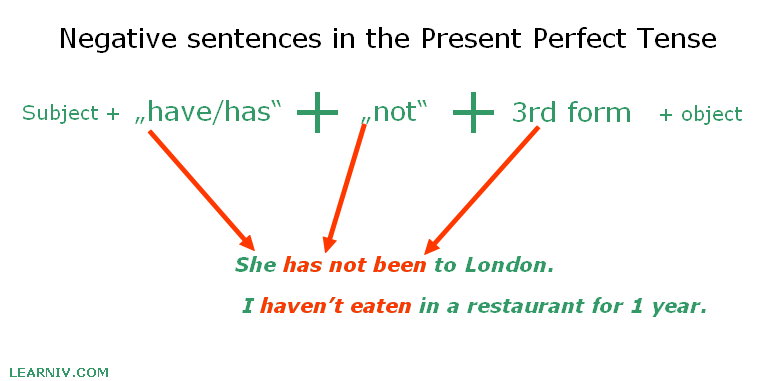
Example:
- I have not seen that movie.
- She has not finished her work yet.
- They have not traveled abroad.

Interrogative Sentences
Interrogative sentences in the Present Perfect tense are used to ask questions about actions or events that have happened in the past with a connection to the present. The structure of interrogative sentences in the Present Perfect tense is as follows:
Have/Has + subject + past participle + (complement) + ?

Example:
- Have you studied for the exam?
- Has she visited that museum?
- Have they completed the project?

It’s important to note that the auxiliary verb “have” changes based on the subject. We use “have” for the pronouns “I,” “you,” “we,” and “they,” and “has” for the pronouns “he,” “she,” and “it.”
By understanding and applying the appropriate sentence structures for affirmative, negative, and interrogative sentences in the Present Perfect tense, you can effectively communicate about past events and experiences in English.
Using “Have” and “Has”
Subject-Verb Agreement
Subject-Verb Agreement in the Present Perfect Tense
Subject-verb agreement is crucial in constructing grammatically correct sentences in the Present Perfect tense. When the subject is in the first- or second-person (singular or plural), we use “have” as the auxiliary verb. For example, “I have visited,” “We have learned,” or “You have studied.” When the subject is in the third-person singular (he, she, it), we use “has” as the auxiliary verb. For example, “He has arrived,” “She has finished,” or “It has started.” This agreement ensures that the verb matches the subject in number and person.
When to Use “Have” and “Has”
The choice between “have” and “has” depends on the subject of the sentence. We use “have” with subjects such as “I,” “you,” “we,” and “they.” For example, “I have seen the movie,” “You have finished your work,” “We have visited many countries,” or “They have read the book.” On the other hand, we use “has” with singular subjects like “he,” “she,” or “it.” For example, “He has traveled to Paris,” “She has completed her project,” or “It has snowed all night.” Understanding this distinction is essential for constructing grammatically accurate sentences in the Present Perfect tense.
- Other examples:
Forming the Past Participle
Building Verb Forms
Regular Verbs in the Present Perfect Tense
Regular verbs form the past participle by adding “-ed” or “-d” to the base form of the verb. For example, “walk” becomes “walked,” “play” becomes “played,” and “talk” becomes “talked.” To construct sentences in the Present Perfect tense with regular verbs, simply combine the appropriate form of “have” or “has” with the past participle. For instance, “I have walked in the park,” “She has played the piano,” or “They have talked about their plans.”
Irregular Verbs in the Present Perfect Tense
Irregular verbs have unique forms for the past participle and do not follow the standard “-ed” or “-d” pattern. Some common examples include “go” (gone), “eat” (eaten), and “see” (seen). It’s essential to familiarize yourself with the irregular verb forms to use them correctly in the Present Perfect tense. For instance, “I have gone on vacation,” “She has eaten sushi,” or “They have seen a movie.”
Time Expressions and Adverbs
Adding Context to Your Sentences
Using Time Expressions in the Present Perfect Tense
Time expressions provide additional context to sentences in the Present Perfect tense. They indicate when the action or event happened or how long it has been going on. Common time expressions include “just,” “already,” “yet,” “since,” and “for.” For example, “I have just finished my homework,” “She has already visited that museum,” or “Have you finished your project yet?”
Adverbs that Work with the Present Perfect Tense
Adverbs play a significant role in the Present Perfect tense by emphasizing the result or duration of an action. Adverbs such as “always,” “often,” “never,” and “recently” provide insights into how frequently an action has occurred. For instance, “He has always been punctual,” “She has often traveled abroad,” or “I have never seen such a beautiful sunset.”
Common Uses of the Present Perfect Tense
Practical Applications
Expressing Past Experiences and Achievements
The Present Perfect tense is commonly used to discuss past experiences and accomplishments. It highlights the connection between the past and the present. For example, “I have visited Paris,” “He has won several awards,” or “They have graduated from university.”
Discussing Unfinished Actions with Present Relevance
When discussing actions that started in the past but have a connection to the present, the Present Perfect tense is ideal. It conveys the idea that the action is ongoing or has an impact on the present moment. For instance, “She has worked at the company for five years,” “We have lived in this neighborhood since 2010,” or “They have known each other since childhood.”
Present Perfect vs. Simple Past
Understanding the Difference
Differentiating the Present Perfect and Simple Past Tenses
While both the Present Perfect and Simple Past tenses refer to past events, they differ in their usage and implications. The Present Perfect emphasizes the connection to the present and often includes time expressions like “just,” “already,” or “yet.” The Simple Past, on the other hand, focuses solely on the past without any connection to the present. Understanding this distinction is crucial for accurate communication.
Clear Examples of Present Perfect vs. Simple Past
To illustrate the difference between the Present Perfect and Simple Past tenses, consider these examples:
- Present Perfect: “I have seen that movie.” (There is a possibility of seeing it again or discussing it further.)
- Simple Past: “I saw that movie.” (The action happened in the past, with no direct connection to the present.)
Conclusion
Mastering the Present Perfect tense is an essential skill for English learners. By understanding the formula, subject-verb agreement, forming the past participle, using time expressions and adverbs, and differentiating it from the Simple Past tense, you can confidently communicate about past experiences and actions with present relevance. Practice using this tense in various contexts to become proficient in expressing yourself accurately and fluently in English.