
The past perfect tense is used to show that something happened before another action in the past. It is also called pluperfect.
The past perfect, sometimes called pluperfect, describes events in the past. This is a specific type of tense and even when it seems hard to use, it is actually pretty easy. This tense describes events that happened in the middle of another event in the past, or which „passed in the past“. To construct the past perfect tense, we need to know all the irregular verbs and their forms.
Look at past perfect tense examples.
The formula for the past perfect tense
To form the past perfect tense we need to use verb „have“ in its irregular form, meaning we will always use „had“. The verb „had“ is combined with a verb in the past participle form (in the 3rd form).
The past perfect tense is easier in the sense that we do not have to distinguish plural or singular subjects or persons. We just always use the verb „had“ before the main verb, no matter what.
The complete sentence would be as follows:
Subject + had + past participle + object.
Differences between the past perfect tense and other tenses
Understanding the differences between the past perfect tense and other tenses is essential for mastering English grammar. The past perfect tense is often compared with the past simple, present perfect, and past perfect progressive tenses. This article will highlight these differences to help you use these tenses accurately.
Past perfect vs. past simple
The past simple tense is used to describe actions that were completed at a specific time in the past. It does not necessarily show the sequence of events.
Past perfect and past simple are described in detail in a separate article where we focus on their differences.
Examples:
-
- She finished her homework last night.
- They left the party at 10 PM.
Key difference:
The past perfect tense emphasizes the completion of an action before another past action, whereas the past simple tense merely states that an action occurred in the past.
Past perfect vs. present perfect
The present perfect tense is used to describe actions that occurred at an unspecified time in the past and are relevant to the present. It often highlights the experience or result of the action.
Past perfect and present perfect are described in detail in a separate article where we focus on their differences.
Examples:
-
- He has already left the office.
- She has never seen such a beautiful sunset.
Key difference:
The past perfect tense places actions in the past in relation to other past events, while the present perfect tense connects past actions to the present, often indicating their relevance or result.
Past perfect vs. past perfect progressive
The past perfect progressive (continuous) tense emphasizes the duration or ongoing nature of an action that continued up to a certain point in the past or until another action occurred.
Past perfect and past perfect progressive are described in detail in a separate article where we focus on their differences.
Examples:
-
- She had been finishing her homework before she went out to play.
- They had been living in that house for five years before moving.
Key difference:
The past perfect tense focuses on the completion of an action before another past event, whereas the past perfect progressive emphasizes the ongoing nature and duration of an action leading up to another past event.
Additionally, it’s important to be aware of the past perfect subjunctive, which is used in hypothetical situations and contrary-to-fact conditions in the past. This topic is explored in detail in a separate article.
Summary
By understanding the differences between the past perfect tense and other tenses, such as the past simple, present perfect, and past perfect progressive, you can more accurately convey the timing and sequence of past actions. Use the past perfect tense to highlight completed actions before another past event, the past simple to state specific actions in the past, the present perfect to connect past actions to the present, and the past perfect progressive to emphasize ongoing actions leading up to another past event. Mastering these distinctions will enhance your clarity and precision in communication.
When do we use the past perfect tense?
We use the past perfect on many occasions. This tense is used to specify events in the past. In contrast to the past simple, in the past perfect tense we know when the action happened and can find more specific information about the sequences of events.
Completed action before something else in the past
The past perfect tense is often used to describe something that occurred before another event in the past. We can also use it for actions that happened before a specific point in time in the past.
Example:
- I did not have a lot of money because I had lost my job.
- I had never seen anything like that before I came to New York.
- She knew what was going to happen in that movie because she had read the book.
All of these sentences are describing actions that happened before another action in the past. We use very often adverbs like „because“ or „before“.
Duration of the event in the past
We use the past perfect tense to describe that some event had lasted in the past before some other event/action happened. We use it when something started in the past, had duration and continued until another action occurred.
Example:
- Before I broke my car, I had had it for 10 years.
- They were sad about giving their dog away because he had lived with them for 4 years and was a part of their family.
Notice that in the first sentence we use the verb „had“ twice. If we want to describe that we had something (owned it), we need to use the verb „had“ to describe its past perfect and another verb „had“ as the main verb in its past participle form.
When do we NOT use the past perfect tense?
We do not use the past perfect tense when we are not trying to convey a sequence of events. If you are just telling someone some information from the past with no sequences, do not use the past perfect. Use it only if the events you are talking about are following some other events.
But if you are asked to answer a question like the following, you will use the past perfect tense:
- „What did you do after you found out she was cheating on you?“
- You will answer with „I had broken up with her.“
Because your answer follows an event in the past, you will use the past perfect tense. In the above case we used the past perfect because it „passed in the past“. If there is no context, do not use the past perfect. Use the past perfect only if it is clear what you are talking about and others know the sequence of events.
We have prepared a complete list of irregular verbs in English. It contains more than 600 verbs, sorted by difficulty.
Forming sentences in the past perfect tense with examples
Affirmative sentences
Affirmative sentences in the past perfect tense are formed using the 3rd form of the verb „have“ and a verb‘s 3rd form (past participle). In contrast to the past simple, we do not care about the number of subjects or whether they are singular or plural. All subjects are used in combination with „had + past participle“.
This tense is a little harder because we need to know all of the verbs used as well as their irregular forms. If we do not memorize them and do not know them, we are unable to construct a full sentence.
The complete sentence would be as follows:
Subject + had + past participle + object.
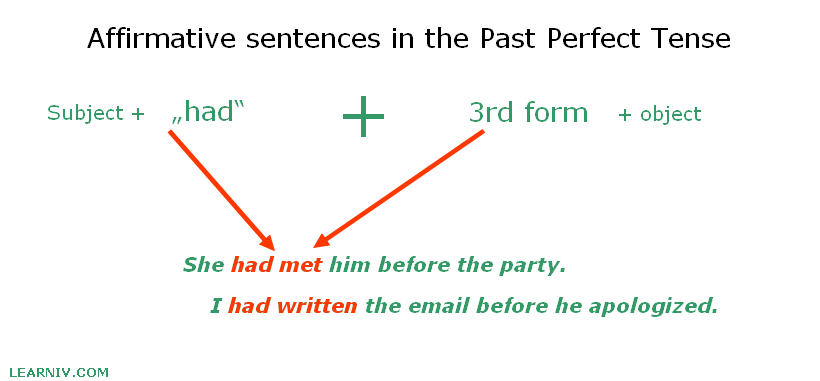
Example:
- I had never been to London until today.
- After she had done her homework, she played football.
- I didn’t say a word until she had finished her story.
Negative sentences
Negative sentences in the past perfect tense are formed by using the auxiliary verb „had not“ or its shorter form „hadn‘t“. We put it in front of the main verb in the past participle.
The complete sentence would be as follows:
Subject + had not/hadn’t + verb in past participle + object.
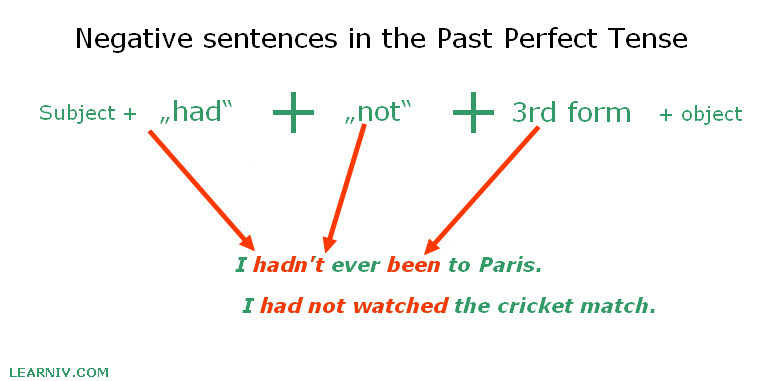
Examples:
- I had not ever eaten in this restaurant until this day.
- I hadn’t ever been to Paris before moving there.
- She hadn’t had time to explain it before seeing him.
Just like with affirmative sentences, we do not distinguish between the person or singular/plural subject.
Questions – interrogative sentences
Interrogative sentences in the past perfect tense are formed by putting the verb „had“ at the beginning of the sentence. We even put it in front of the subject.
The rest of the sentence is similar to affirmative sentences. In questions we still use the verb in its past particular form, so the only difference between affirmative sentences and questions is in the positioning of the verb „had“.
The complete sentence would be as follows:
Had + subject + verb in past particular + object?

Examples:
- When had she eaten?
- Where had she disappeared to?
- Had you ever been to London before you moved there?
Are you interested in more examples of sentences with past perfect tense?
Adverbs in the past perfect tense
In the past perfect tense, we often use a lot of adverbs that help us describe situations much easier. Thanks to these adverbs, we do not have to explain specific information about events in the past as they describe everything we need to know.
The adverb „just“
We use „just“ in the past perfect tense if we want to talk about an event that happened only a short time before another action.
Example:
- The train had just left when I came to the station.
- The thief had just run when the police came.
- I had just whipped the cream when my oven started to burn.
The adverb „already“
The adverb „already“ is used to describe events before the specified time.
Example:
- I called her but she had already left.
The adverb „still“
The adverb „still“ is used for actions that were happening in the past for a longer period of time.
Example:
- He still hadn’t come to any meetings in the first part of June.
- It still had not rained, even in August.
The adverb „ever“
We use this adverb in the past perfect when we talk about any time before a specific point in the past.
Example:
- Had you ever been to Paris before you moved there?
The adverb „never“
This adverb is used to talk about something that never happened before a specific point in the past.
Examples:
- I had never felt something like that before I met you.
- She had never been so happy until she changed schools.
Verbs in Past Perfect Tense
The past perfect tense plays a crucial role in English grammar. Understanding how verbs in past perfect tense function is essential for constructing accurate and meaningful sentences.
Construction of Verbs in Past Perfect Tense
To form the past perfect tense, use the auxiliary verb “had” followed by the past participle of the main verb. The structure remains consistent regardless of the subject’s number or person.
Regular and Irregular Verbs
Both regular and irregular verbs are used in the past perfect tense. The distinction lies in forming their past participles.
Regular Verbs: For regular verbs, the past participle is formed by adding “-ed” to the base form of the verb.
Examples:
- work → worked
- play → played
Irregular Verbs: Irregular verbs have unique past participle forms that must be memorized.
Examples:
Usage with Adverbs
Adverbs can be used with verbs in the past perfect tense to provide additional context and detail.
Examples:
- She had just finished her homework when the phone rang.
- By the time we arrived, they had already left.
Common Mistakes
A common mistake with the past perfect tense is using it when not necessary. Ensure there is a clear sequence of events that warrants the use of the past perfect.
Incorrect:
- I had gone to the store. (no sequence of events)
Correct:
- I had gone to the store before it started raining.
Understanding how to correctly form and use verbs in the past perfect tense allows for more precise and effective communication about events that occurred in the past relative to other past actions.