Present Perfect JUST, ALREADY, YET

10/10 - (4 votes)
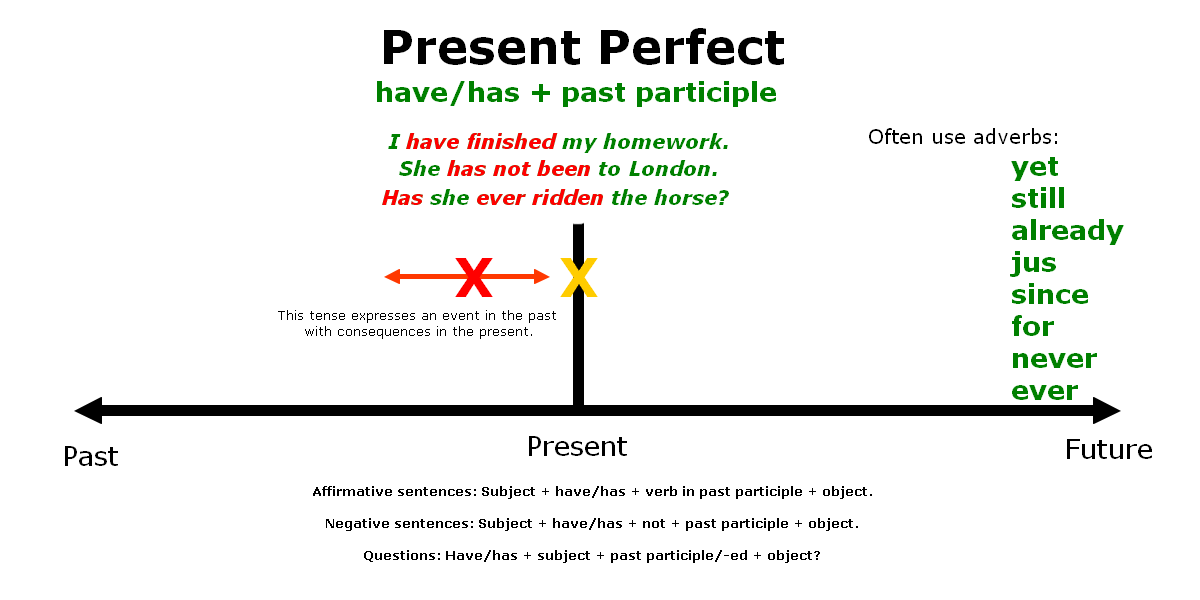
In English, the words “just,” “already,” and “yet” are commonly used in the present perfect tense to indicate the timing or completion of an action or situation. Here is a detailed explanation of each word in relation to the present perfect tense. JUST “Just” is used to indicate an action that happened a short time… Continue reading Present Perfect JUST, ALREADY, YET

Published
Categorized as Tenses

Present Perfect with FOR and SINCE

10/10 - (3 votes)

In English, the present perfect tense is often used to talk about actions or situations that started in the past and continue into the present. The duration of these actions or situations can be expressed using “since” and “for.” SINCE “Since” is used to indicate the starting point of an action or situation. It is… Continue reading Present Perfect with FOR and SINCE

Published
Categorized as Tenses

Present Perfect irregular and regular verbs list

10/10 - (8 votes)

The English language offers a variety of verb forms and tenses to accurately express different actions and states. One of these essential tenses is the Present Perfect. Understanding how it works, along with the differences between irregular and regular verbs, is crucial for effective communication. In this article, we will explore the Present Perfect tense,… Continue reading Present Perfect irregular and regular verbs list

Published
Categorized as Tenses

20 Examples of sentences of Present Perfect Tense

9.9/10 - (38 votes)

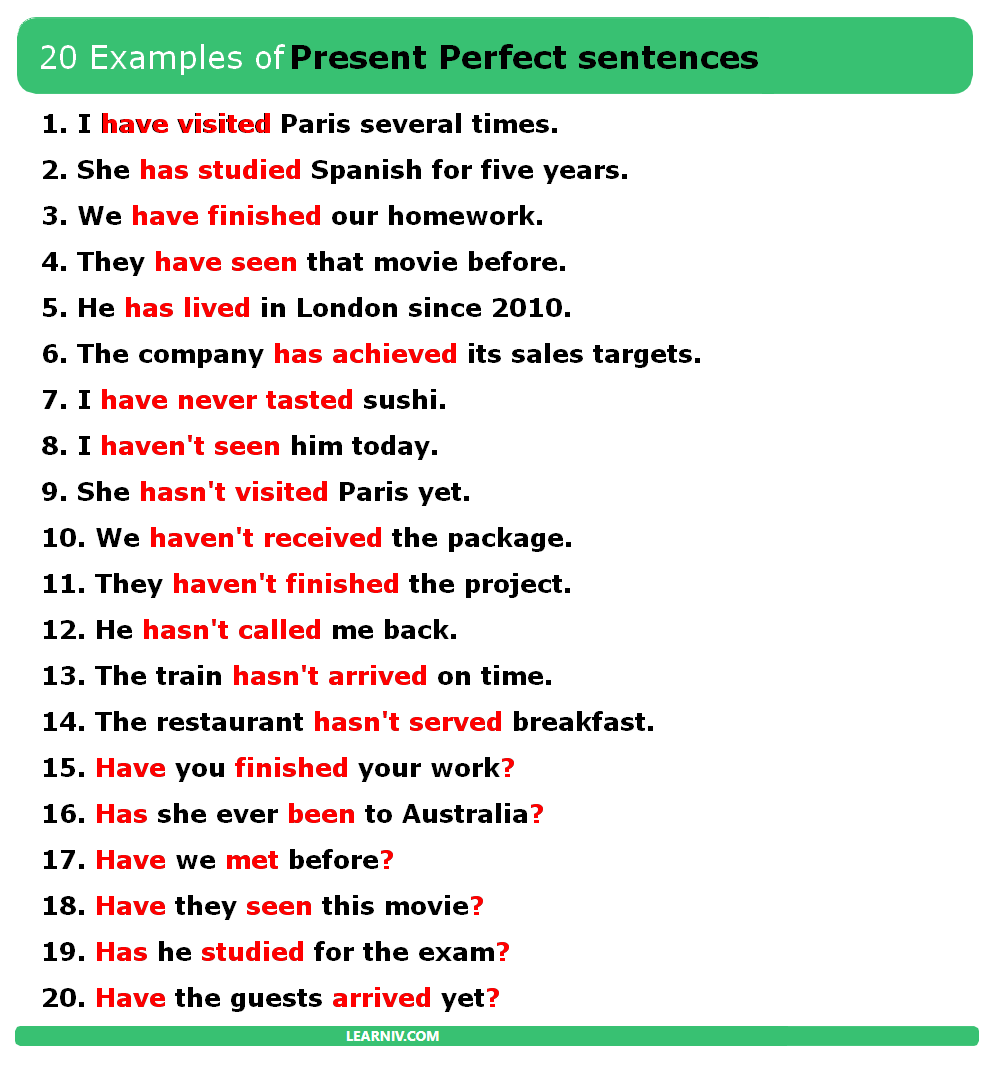
The Present Perfect tense is a grammatical structure used to describe events or incidents that happened in the past but have significance in the present. It emphasizes the result or effect of the action rather than its specific timing. Its creation involves using the auxiliary verbs “have” or “has” followed by the past participle of… Continue reading 20 Examples of sentences of Present Perfect Tense

Published
Categorized as Tenses

50 Examples of sentences of Present Perfect Tense

10/10 - (14 votes)

The Present Perfect tense is a grammatical construction utilized to depict actions or occurrences that transpired in the past but bear relevance to the present. It accentuates the outcome or impact of the action rather than its precise timing. Its formation entails the utilization of the helping verbs “have” or “has” followed by the past… Continue reading 50 Examples of sentences of Present Perfect Tense

Published
Categorized as Tenses

Use of the Present Perfect Tense

10/10 - (15 votes)

The Present Perfect tense is used in several situations: To talk about past actions or events with a present relevance: When the past action or event has a connection to the present moment or its effects are still felt, the Present Perfect is used. For example: “I have lost my keys” (the keys are still… Continue reading Use of the Present Perfect Tense

Published
Categorized as Tenses

Verbs in the English Present Continuous (progressive)

10/10 - (7 votes)

There are several verbs that are not typically used in the present continuous tense (also known as the present progressive tense). Some verbs are not typically used in the present continuous tense because they represent states, qualities, or non-action verbs. These verbs describe conditions or characteristics that are not usually associated with ongoing or temporary… Continue reading Verbs in the English Present Continuous (progressive)

Published
Categorized as Tenses

The Structure of the Present Continuous (progressive) Form

10/10 - (4 votes)

The present continuous (progressive) form is a fundamental aspect of the English language. It allows us to describe actions or situations happening at the current moment or in the near future. In this blog post, we will delve into the structure of the present continuous tense (also known as present progressive tense), exploring its components… Continue reading The Structure of the Present Continuous (progressive) Form

Published
Categorized as Tenses